
Before the Memes, How Satire Has Always Challenged the Status Quo
Satire and parody have long served as the ultimate tools for taking the powerful down a peg and pulling a king off his throne. These humorous forms are far more than frivolous entertainment because they act as a necessary social corrective. By exaggerating folly and vice, satirists force audiences to see exactly what is being concealed behind a polished public image. As research suggests, political satire is designed to keep those in power in check by allowing the masses to laugh at our collective mess. In practice, a joke directed at a politician or a religious institution isn’t just mean-spirited. It is meant to inform or embarrass in a way that reveals blatant hypocrisy.
Modern research confirms that satirical comedy can actually function like the nightly news. Viewers of comedy shows like The Daily Show or The Colbert Report pick up significant real-world information from these segments. Humorous stories are often shared and remembered more readily than plain, dry reporting. This means a well-timed meme or a late-night gag can actually do more to boost public awareness of an issue than a standard op-ed ever could. Basically, if you can make someone laugh at a problem, you have already won the hardest part of the battle: making them care.
 The idea that ridicule can reform society is not new. Historians point to the 18th century as the actual birth of what we recognize today as political satire. The Enlightenment brought a rise in press freedom that gave satirists fresh ammo to target the elite. Caricaturists like William Hogarth and James Gillray turned high-society scandals and government corruption into woodcut prints that circulated on street corners. These were the 1700s version of a viral thread. In America, Benjamin Franklin famously created the “Join, or Die” cartoon in 1754, which depicted the colonies as a chopped-up snake. It was stark and unmistakably satirical, using a grotesque metaphor to force a conversation about unity.
These cartoons were never mere decoration. They were targeted political messaging printed on pamphlets and broadsheets for the average person to digest. By the American Revolution, editorial cartoons were common on both sides of the Atlantic, lampooning royalty, religious leaders, and war efforts. One account notes that by the era of the Bill of Rights, producing independent political cartoons was a routine part of public debate.
Predictably, the people in charge took notice. Britain passed laws like the Licensing Act and Stamp Act specifically to censor and tax satirical publications. The government understood a dangerous truth: once a king or official can be mocked publicly, their mystique begins to crumble. Satirists understood this dynamic instinctively. They pounded on the veneer of authority to show that under the finery and ceremony, leaders were just as human and hypocritical as everyone else.
The Cartoon Wars
Fast-forward to today’s pop culture and no show embodies that spirit more overtly than South Park. The long-running animated sitcom by Matt Stone and Trey Parker famously spares no target. As The Guardian notes, Mormons, Scientologists, Catholics, Jews, politicians, and film stars have all been skewered by the show’s razor-sharp wit. Over its history, South Park has launched multiple controversies by lampooning religion and celebrity with zero hesitation.
Mormonism and the “Affectionate” Roast
The 2003 episode “All About Mormons?” stands as one of the show’s most unique cultural contributions by balancing sharp theological skepticism with surprising heart. The episode famously retells the story of Joseph Smith (New Yorker by like where he grew up so he’s one of us in that regard) and the founding of the Church of Jesus Christ of Latter-day Saints (Mormons) through a series of “historical” flashbacks. These sequences were set to an upbeat, recurring musical motif, i can only call it the “Dumb, Dumb, Dumb, Dumb” song, which pointedly to quote Peter Griffin of Quahog, “insists upon itself” and highlighted the more fantastical elements of the religion’s origins, such as the “Golden Plates” and the lost 116 pages of the Book of Mormon.
Despite the relentless mocking of the doctrine, the episode is widely considered an “affectionate roast.” Unlike the show’s more vitriolic takedowns of Scientology which I will talk about shortly, the Mormon family in the episode (the Harrisons) are portrayed as the kindest and most well-adjusted group in South Park. This created a clever comedic juxtaposition where the beliefs were framed as nonsensical, yet the result of those beliefs was a family so genuinely nice that they eventually won over renowned glass half empty supporter, Stan Marsh. Parker, who grew up in Colorado around many Mormons, later observed that while some critics were offended, many of his LDS friends found the parody hilarious because it accurately reflected their history through a satirical lens.
The episode served as a “proof of concept” for Matt and Trey’s later creative ventures. The DNA of “All About Mormons?”, specifically the mix of theological absurdity, catchy show tunes, and a “love the people, mock the ideas” philosophy directly paved the way for their massive Broadway hit, The Book of Mormon. (which I still need to see) The musical would go on to win nine Tony Awards and become a global phenomenon, proving that South Park’s brand of irreverence could actually be used to tell a story about faith that was as touching as it was “blasphemous” while still confronting the ‘issues’ Parker and Stone had with the religion.
Scientology and the “Closet” Firestorm
In the 2005 episode “Trapped in the Closet,” South Park targeted Scientology’s secrecy and its most famous members with unprecedented aggression. The plot follows Stan as he joins the church and discovers he has such a high “thetan” count that he is declared the reincarnation of L. Ron Hubbard. The episode generated a massive media firestorm, but the drama behind the scenes was even more intense. Reports surfaced that the Church’s Office of Special Affairs launched a covert investigation into creators Matt Stone and Trey Parker, allegedly using an informant to sift through their trash and phone records in a desperate search for “dirt.”

The satire was particularly pointed toward Tom Cruise, whom the animators relentlessly mocked by drawing him significantly shorter than other characters, who if you are not familiar, are kids. The episode’s central gag involved Cruise literally locking himself in a bedroom closet and refusing to “come out,” a transparent jab at long-standing rumors regarding his sexuality. The fallout was swift: a scheduled rebroadcast was infamously pulled from the air allegedly after Cruise threatened to boycott his Mission: Impossible III press tour, and the controversy eventually led to the departure of Isaac Hayes (the voice of Chef), a devout Scientologist. Though following his passing, his son seemed to confirm that it was not Isaac Hayes’ choice to leave the show that his ‘handlers’ made the decision for him.
Comedy Central eventually doubled down, placing trade ads that cheekily urged fans to “show Scientology who really runs Hollywood.” By mocking a powerful, litigious, and celebrity-backed institution, South Park put a modern taboo on full display, proving that no one was “untouchable”.
The Muhammad Controversy and the Limits of Irreverence
Religion and free speech clashed most dramatically in the 2010 episodes “200” and “201,” marking a turning point for the show’s relationship with its own network. While South Park had previously featured Muhammad in the 2001 episode “Super Best Friends” as a flame-throwing superhero without any backlash, the climate had shifted by 2010. Following the 2005 Danish cartoon controversy (look it up its nuts), depicting the Prophet had become a global flashpoint. Parker and Stone leaned into this tension, turning Muhammad into a literal plot device: a “power” that celebrities like the aforementioned Tom Cruise wanted to ‘harvest to become immune to ridicule’.
The satire quickly spiraled into a real-world crisis. After “200” aired, showing Muhammad hidden inside a bear costume, an extremist group posted a “warning” on their website. They claimed the creators would “probably wind up like Theo van Gogh”, a Dutch filmmaker who was murdered for his work criticizing Islam, and they posted the addresses of Comedy
Central’s New York headquarters. Terrified of a violent escalation, Comedy Central took the unprecedented step of gutting the sequel, “201.” They didn’t just place a “CENSORED” bar over the image; they bleeped every single mention of the name “Muhammad” and, most famously, censored Kyle’s entire closing monologue.

Parker and Stone released a statement clarifying that the 45-second bleep at the end wasn’t a “meta-joke” they had written, but a network-mandated scrub of a speech that was actually about intimidation and fear. By silencing a speech against using violence to get your way, the network inadvertently proved the episode’s point: that terrorism, on a corporate level, works. To this day, these episodes remain “banned” from most streaming platforms, serving as a permanent scar on the show’s “nothing is sacred” record.
Ultimately, by going after such diverse targets, South Park proves that satire is at its best when it is fearless. I read that a network spokesperson summed it up by noting that Parker and Stone have been free to satirize anybody and anything they want. Whether poking fun at a benign Mormon home or lampooning a secretive, litigious church, the show uses humor to question belief and authority alike.
The Evolution of the Political Meme
Alongside traditional TV satire, the internet has birthed entirely new forms of parody that function as digital pamphlets for the 21st century. Memes, viral videos, and social posts now spread commentary faster than any 18th, 19th century printing press ever could. These digital artifacts echo old school editorial cartoons by using absurdity to puncture the power, often turning a leader’s own image or words against them in a way that is nearly impossible to censor.
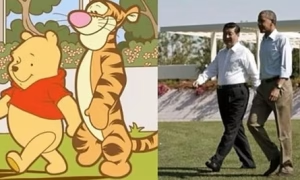
A prime example of this is the enduring comparison between Chinese President Xi Jinping and Winnie the Pooh. What began as a harmless 2013 social media post, noting that a photo of Xi walking with Barack Obama looked remarkably like Pooh walking with Tigger (see below… alongside?) morphed into a high-stakes game of cat-and-mouse. The Chinese government, viewing the comparison as a serious affront to the dignity of the presidential office, began scrubbing the bear’s image from domestic search engines and social media platforms. A beloved childhood icon was simply banned from the largest country in the world. By 2018, even the Disney film Christopher Robin was denied a release in China, further fueling the as coined by South Park “Streisand Effect”, where the act of censorship only made the meme more famous globally.
During global protests, activists have weaponized this specific kind of satire to bypass traditional restrictions. In 2024 and 2025, activists in Taiwan and Hong Kong used Winnie the Pooh imagery on shoulder patches to signal resistance to Beijing’s influence without using explicit political language. Back in our homeland (USA USA), viral debate clips are instantly transformed into “remixes” and linguistic shorthand. Moments that years ago would just be flashes in the pan, such as Kamala Harris’ “Coconut Tree” and Donald Trump’s “Eating the Dogs” moments, are now forever intertwined in TikToks, meme culture across the world, in places where people may not have been privy to these debates, speeches, etc. These memes serve to either humanize a candidate through “absurdist relatability” or mock them for bizarre rhetorical claims, proving that a single 10-second clip can have more political impact than a hundred policy papers.
This global reach proves how parody spreads across social media to fuel discussions that traditional news often misses. By turning a powerful figure into a “cute” or “ridiculous” character, memes strip away the aura of untouchability, making them one of the most effective tools for modern political commentary.
Late-Night Satire and the Cultural Frontline
Late-night comedy has shifted from being a source of light entertainment to a primary lens through which millions of people digest reality. Comedians like Stephen Colbert and John Oliver regularly tackle complex policy and current events with a level of sarcasm that resonates with a younger, more skeptical audience. This is not just about getting a laugh; research indicates that humor acts as a gateway drug to political engagement. Studies show that viewers of news-parody shows tend to discuss politics more frequently and retain more facts than those who only watch serious news broadcasts. Satire effectively educates by surprise, making information stick in a way that a dry lecture might fail.
 As satire becomes more intertwined with political culture, the stakes for comedians have become increasingly real. A major flashpoint occurred in September 2025 with the high-profile suspension of Jimmy Kimmel. Following a monologue regarding the assassination of ring-wing activist Charlie Kirk, several major broadcast affiliates refused to air his show, labeling his comments as insensitive. Under intense pressure from government officials and the threat of regulatory action from the FCC, ABC and Disney took Jimmy Kimmel Live! off the air for nearly a week. Now I vehemently do not agree with the tone Kimmel took, the words he spoke, nor just anything he says usually but I am a huge supporter of the first amendment. It’s one of the reasons why for all of our country’s flaws that this still is the greatest country in the world. Jimmy Kimmel shouldn’t have been removed for the time from TV, let him be an idiot and let people hate on him for that, but he did nothing legally wrong.
President Trump publicly celebrated the suspension on social media, incorrectly labeling it a permanent cancellation and suggesting that “bad ratings” were the true cause. When Kimmel eventually returned to the air, I agreed with him for maybe the first time ever, and he used his first monologue to argue that government threats against comedians are fundamentally anti-American. This incident sparked a national firestorm regarding free speech, with critics pointing to the suspension as a dangerous precedent where corporate media felt compelled to muzzle a satirist to avoid political retaliation. This event proved that late-night satire is no longer just the jokes at the end of the day; it has become a central battleground in the war over what can be said in the public square.
The Key Forms of Satirical Critique
 Now, as I discussed at noisome, modern satire utilizes a diverse toolkit to challenge power, with each medium offering a unique way to dismantle official narratives. Editorial cartoons and animations continue a centuries-old tradition of using caricature to strip leaders of their perceived dignity. By simplifying complex geopolitical tensions into digestible visuals much like Benjamin Franklin’s famous “Join, or Die” severed snake, these artists create an immediate emotional and intellectual impact that transcends language barriers.
Television comedy has evolved into a sophisticated news-parody format that dissects speeches, scandals, and policies in real-time. By mimicking the aesthetic and cadence of traditional journalism, shows like The Daily Show or Last Week Tonight can expose the absurdity of a political statement simply by juxtaposing it with the facts. This “news-adjacent” satire acts as a secondary check on the media, often pointing out the contradictions that standard news broadcasts are too polite to mention.
The rise of internet memes has democratized the satirical process, allowing for widespread public participation. Through viral images, GIFs, and TikTok parodies, a single captioned photo can lampoon a politician or a global trend in seconds. This form of satire is particularly potent because it is decentralized; it doesn’t require a network budget or a printing press to reach millions, making it nearly impossible for authorities to fully suppress.
 On the physical front, street theatre and protest art remain vital tools for activists. By deploying murals, giant puppets, and live performance art, protesters blur the line between creative expression and political outrage. These spectacles force passersby to confront the status quo in a way that is visually unavoidable. No matter the medium, all these forms of satire share a singular goal: to question official narratives. By framing the familiar as something absurd, satire pries open the space necessary for critical thinking, forcing us to stop taking the world for granted and start the process of actually paying attention.
No matter the medium, satire shares one singular goal: to question official narratives. By framing the familiar as something absurd, satire pries open the space necessary for critical thinking. It forces us to stop taking the status quo for granted and starts the process of actually paying attention.
The Last Line of Defense: Satire as a Shield for Truth
Laughter is a powerful tool, but it undeniably has its boundaries. When it’s overdone, comedy can normalize cynicism and leave people feeling jaded rather than informed. There is also the constant risk that an audience will totally misinterpret irony as sincerity. When satire crosses certain lines, it draws immediate and heavy handed backlash. We saw this with the Muhammad episodes of South Park, where humor sparked real world threats and led to the network basically gutting the creators’ work. Whether it’s a church official decrying an episode or a public figure like Donald Trump or Tom Cruise angrily tweeting about a skit, the pushback is a constant reminder that satire carries a real cost.
Despite those risks, the effect of satire is overwhelmingly positive. It democratizes the conversation by making complex issues accessible to everyone. Even the controversies serve a purpose by boosting public attention. When South Park faced the firestorm over Scientology, the uproar drew millions of new eyeballs to the show’s underlying critique. It was the gift that kept on giving for publicity. Satire also relies on a high level of self awareness. By poking fun at the very debates surrounding free speech, the comedy functions less like simple mockery and more like a mirror for society. It forces us to look at our own contradictions.

Ultimately, the success of a joke depends on context. Effective satire has to have a legitimate connection with its audience by channeling shared frustrations. This explains why Matt and Trey could lampoon Mormon culture in friendly terms that people in Utah embraced, while simultaneously going for the throat against the more secretive edges of Scientology. Satire requires this common ground to function. Without it, the message just falls flat.
From 18th century woodcuts to viral Winnie the Pooh patches in Taiwan, satire and parody have served as vital checks on authority. They remind us that no speech or “untouchable” hero is exempt from ridicule. When a politician’s promise is turned into a joke, we get a rare chance to see beyond the polished slogans. Good satire makes the people in power uncomfortable, and that discomfort forces the rest of us to reflect on the world we are actually living in.
In an age of 24/7 media, it is easy to write satire off as empty cynicism or a cheap TikTok remix. However, it carries weight by shaping opinions and keeping public conversations honest. Whether it is a religious figure in a bear costume or singing about golden plates, the goal isn’t just a laugh; it is the practice of a tool of democracy. Every laugh directed at a pompous leader is a serious act of citizenship. Through humor, we collectively admit that we won’t let anyone sit above scrutiny.
Leave a Reply